
Everything Changes When You Slow the Speed of Touch
By Valerie Briggs
Everything changes when you slow the frequency and speed of human touch.
The Fibonacci sequence appears in some biological growth patterns, including spirals, branching structures, and rhythmic organization (Ball, 2009).

The human hand is built on proportional relationships that favor efficient movement and sensory input, and those same patterns show up in how we guide flow through touch. The hand functions through arcs and spirals, reflecting how biological systems favor patterned, efficient movement over rigid geometry (Buryanov & Kotiuk, 2010).
The body does not respond very well to force. It does respond to patterns and organization.
We often divide the body into systems: lymphatic, nervous, musculoskeletal, as if they operate independently. Living systems communicate through rhythm, timing, and relationship, with breath cycles, heart oscillations, gait patterns, fascial tension, and sensory input interacting continuously.
Across biology, efficiency emerges through synchronization. From cellular signaling to movement, coordinated timing allows systems to function with minimal resistance. What we experience as “flow” is not abstract. It is perceptual and coordinated physiology.
2. Lymphatic Coherence: Flow as Coordinated Physiology
Lymphatic coherence can be defined as coordinated, low-resistance flow across fluid, tissue, nervous system, and perception. Lymphatic health is fundamentally efficient integration across systems. Brain to toes, it’s all connected via lymphatic fluid.

Swelling or fluid accumulation occurs when tissue is sedentary or there is some sort of trauma. It is resistance to lymphatic flow, a road block in the ‘river of health.’ Your lymphatic fluid loves all 37 trillion cells in your body. It carries information about your immune response, your overall health, pathogens, cellular functioning and vital nutrients through newly researched circulatory nano-vessels in the brain, the blood, the muscles, the skin, and your well-being network (Gu et al., (2026).
The lymphatic system is not only a drainage network; it actively regulates inflammation by clearing excess tissue fluid, immune cells, cytokines, antigens, and inflammatory mediators from tissues, while lymphatic dysfunction can prolong inflammation and contribute to chronic disease progression (Schwager & Detmar, 2019; Liao & von der Weid, 2014).
The lymphatic system operates without a central pump. Instead, it relies on diaphragmatic breathing, skeletal muscle contraction, tissue elasticity, and pressure gradients to move fluid through vessels just beneath the skin. Nervous system sympathetic activation or parasympathetic regulation directly influences these conditions.
This makes lymph a coherence-dependent network. When systems are synchronized, fluid moves. When coordination breaks down, fluid lingers. The chart at the end of this article outlines specific speed and frequency of synchronized massage rhythm stroke and frequency for efficient use.
Research on psychophysiological coherence provides further insight into human patterns. McCraty et al. describe coherence as an ordered heart rhythm pattern (~0.1 Hz) and associate synchronization between cardiovascular, autonomic, and cognitive systems. These systems contribute to improved emotional regulation and performance. This suggests that rhythm and timing at one level of the body can influence system-wide efficiency.
Manual lymphatic drainage is often described as a technique that mechanically “moves” fluid, but current evidence suggests its primary effects are better understood through changes in physiological regulation rather than direct fluid propulsion. The lymphatic system relies on intrinsic vessel contractility, pressure gradients, tissue elasticity, and autonomic balance, meaning external input such as touch likely influences the conditions under which fluid can move rather than acting as a substitute for these mechanisms. Research examining manual lymphatic drainage demonstrates measurable changes in cardiovascular and autonomic parameters, including heart rate and circulatory responses, supporting the idea that touch-based interventions can shift systemic state rather than simply displacing fluid (Esmer et al., 2019). More recent controlled trials further reinforce this perspective, showing improvements in physiological and functional outcomes following manual lymphatic drainage interventions, while highlighting variability in response and the importance of context and integration with other therapies (Da Cuña-Carrera et al., 2024).
At the same time, high-quality randomized controlled research has challenged the assumption that manual lymphatic drainage provides unique additive benefits when layered into complete decongestive therapy (Devoogdt et al., 2023; Wanchai et al., 2021).
Taken together, the emerging literature supports a shift in interpretation. Manual lymphatic drainage appears to function less as a direct mechanical driver of lymph movement and more as a form of patterned sensory and mechanical input that can influence autonomic regulation, tissue tone, and local pressure environments. Within this framework, its clinical value lies in its ability to reduce resistance within the system, facilitate more favorable conditions for intrinsic lymphatic function, and integrate with broader physiological processes that govern fluid movement. This aligns with a model of lymphatic coherence in which coordinated interaction between tissue, nervous system, and fluid dynamics determines flow, rather than force applied from outside the body.
3. Human Touch as Rhythmic, Mechanical, and Perceptual Input
Human touch operates across three interconnected layers: anatomically, rhythmic, and perceptual.
Anatomically, light skin stretch and pressure gradients influence lymphatic vessels, which rely on subtle expansion and recoil rather than deep force. Fascia and superficial tissues respond to these small inputs, altering local pressure environments and fluid dynamics, which allows lymphatic fluid to drain from superficial vessels to deep trunks, where it is collected and processed by other body systems.
Rhythmically, repetition and predictable timing matter. The nervous system is highly sensitive to patterned input. Slow, consistent touch can entrain physiological rhythms in a way that abrupt or irregular pressure cannot. This aligns with broader findings that rhythmic practices, such as breathing, chanting, or repetitive movement, can shift autonomic balance toward parasympathetic activity (Telles et al., 1995).
Perceptually, touch changes how the body interprets itself. Sensory input from the skin and fascia feeds into interoceptive networks, influencing how the brain predicts and regulates internal states (Quadt et al., 2018). When touch is slow and predictable, it signals safety. When safety increases, tissue tone decreases. When tissue tone decreases, resistance drops.
A welcome touch leads to tissue regulation, reduced interstitial pressure and improved lymphatic flow.
Massage and touch-based therapies have been shown to influence vagal tone and autonomic function (Field, 2014). The research is consistent: touch changes state, and state changes physiology.
What Are C-Tactile Afferents?
C-tactile (CT) afferents are a specialized class of unmyelinated, slow-conducting sensory nerve fibers located in the skin, particularly in hairy (non-glabrous) skin, that are tuned specifically to gentle, slow, stroking touch rather than pressure or pain (McGlone et al., 2014). Unlike fast, discriminative touch fibers that tell you where and what is being touched, CT afferents signal how that touch feels emotionally and socially.
They respond optimally to touch moving at approximately 1–10 cm per second, which aligns with slow, rhythmic touch patterns similar to the 0.5–1.0 Hz range highlighted in the diagram. This is why slow, gliding touch often feels soothing, safe, or connecting rather than stimulating. When activated, CT afferents project to brain regions involved in interoception and emotional processing, such as the insular cortex, linking physical sensation with subjective experience (McGlone et al., 2014; Olausson et al., 2002).
From a physiological perspective, this makes CT afferents a key bridge between touch and nervous system regulation. Their activation has been associated with increased parasympathetic activity, reduced stress responses, and enhanced body awareness, which may indirectly support processes like reduced tissue tension and improved fluid dynamics (Field, 2014).
4. Fascia: The Medium of Coherence
Fascia is not passive structure. It is a dynamic, sensory-rich network that integrates mechanical and neurological information across the body. It surrounds muscles, nerves, blood vessels, lymphatics, and organs, functioning as both a communication system and a pressure-regulating matrix .
When the body experiences stress or trauma, the nervous system may remain in a protective state. Muscles tighten, and fascia follows. Over time, this creates increased density, reduced elasticity, and higher internal pressure. Chronic stress is linked to sustained autonomic imbalance, increased tissue tension, and heightened inflammatory signaling, ultimately reducing the body’s ability to maintain coordinated, low-resistance physiological function (Morris & Berk, 2015).

This has direct consequences for lymphatic flow:
Increased tissue pressure reduces vessel expansion.
Reduced expansion limits fluid movement.
Fluid meets resistance.
Swelling persists, increases fibrosis and other skin changes.
This is why swelling often worsens under stress. The nervous system in fight or flight mode alters tissue tone, and tissue tone alters fluid dynamics.
Emerging research reframes fascia as a regulatory system involved in whole-body coordination rather than inert packing material (Slater et al., 2024). Earlier models by Langevin and Sherman (2007) similarly connect connective tissue behavior with nervous system function and chronic pain patterns. It’s all connected.
Fascia, in this sense, is the medium through which coherence, or incoherence, propagates.
5. The Spiral of Flow: Pattern Over Force
Across nature, efficient systems organize into patterns such as branching, oscillation, and spiraling. The Fibonacci sequence is one example of how growth and distribution follow ratios that balance stable expansion.
The human body reflects similar principles. Movement occurs in arcs, not straight lines. Gait follows rhythmic timing relationships. Breath cycles influence pressure waves throughout the torso.
Touch, when applied rhythmically and directionally, may mirror these natural organizational patterns. This does not suggest the body is governed by mathematics, but rather that repeated, structured input promotes coordination.
This is the “sacred spiral” reframed as patterned input and adaptive organization.
Practices often labeled as “energy work,” such as Reiki or therapeutic touch, function more through modulation of attention, sensory input, and nervous system state. Reviews of biofield therapies note that while evidence is emerging, consistent effects include relaxation and shifts in perceived well-being (Matos et al., 2021) .
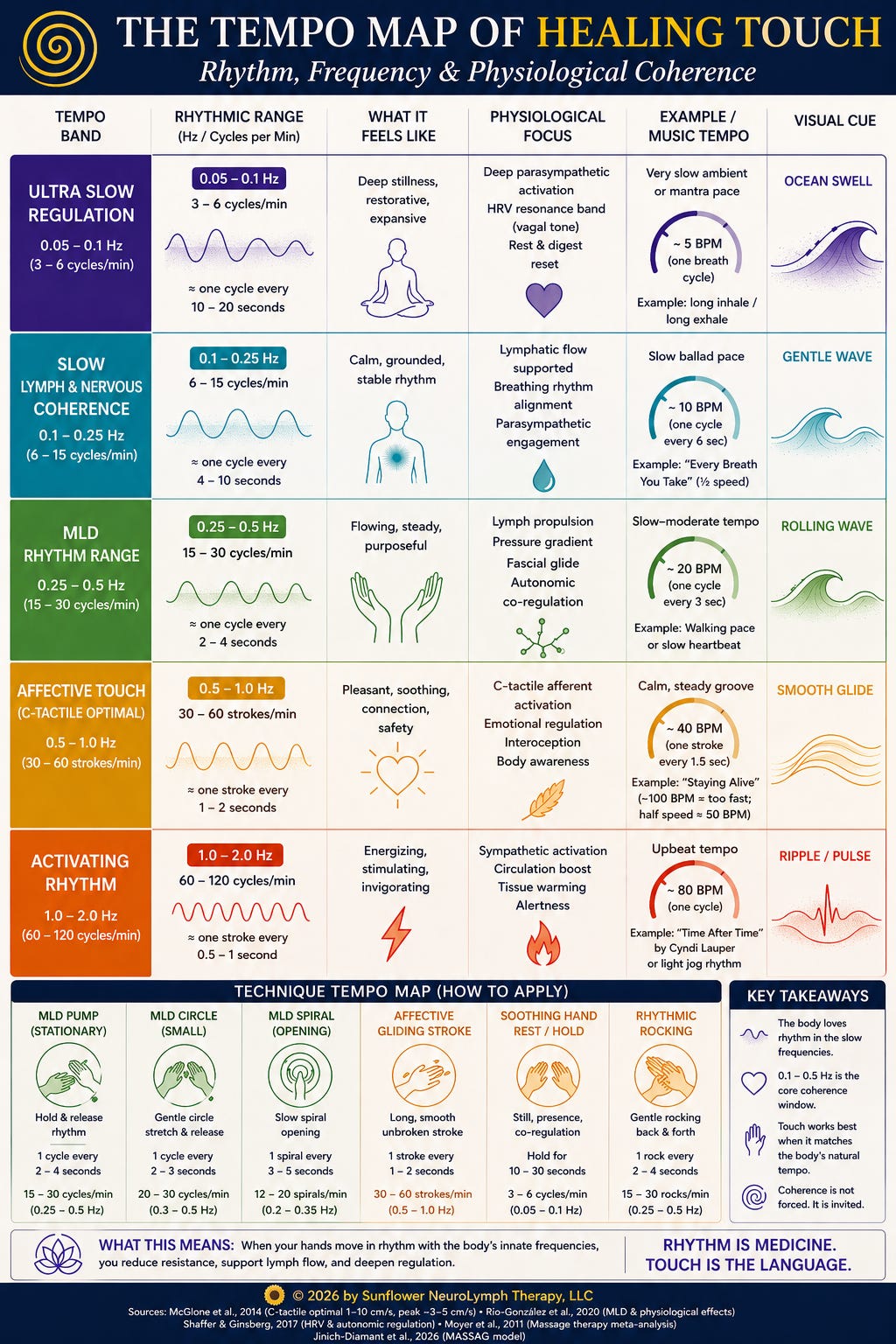
This diagram illustrates how the tempo and frequency of touch can act as regulatory input across physiological systems, with slower, rhythmic touch supporting greater system-wide coherence and faster rhythms increasing activation. At very slow frequencies (0.05–0.1 Hz), touch aligns with deep parasympathetic states and heart rate variability coherence, a pattern associated with synchronized cardiovascular and autonomic function (McCraty et al., 2009).
In this conceptual model, as tempo increases into the 0.1–0.5 Hz range, touch corresponds with optimal conditions for lymphatic movement, supporting pressure gradients, breathing coordination, and fluid propulsion, which are known to depend on tissue elasticity and autonomic balance rather than a central pump (Río-González et al., 2020). Mid-range rhythmic touch (0.5–1.0 Hz) engages C-tactile afferents, specialized nerve fibers linked to affection touch, interoception, and emotional regulation, reinforcing sensations of safety and body awareness (McGlone et al., 2014).
At higher frequencies (1.0–2.0 Hz), touch shifts toward sympathetic activation, increasing circulation and alertness. Overall, the diagram supports the concept that touch is not merely mechanical. It acts as patterned sensory input that organizes interactions between the nervous system, fascia, and lymphatic flow. In this model, coherence emerges through timing, repetition, and reduced resistance rather than force.
6. Integration: Perception as the Final Layer of Flow
What people describe as “flow,” “release,” or even “energy moving” may reflect integrated changes across multiple systems occurring simultaneously.
Fluid begins to move.
Tissue softens.
Breath deepens.
The nervous system shifts.
And perception integrates.
Interoception, the sensing of internal bodily states, plays a key role in this process. As awareness increases, individuals can detect subtle shifts in pressure, movement, and coordination, reinforcing the feedback loop between perception and physiology (Quadt et al., 2018).
Within this framework, human touch becomes a guide rather than a force. It introduces pattern, reduces resistance, and allows the body to reorganize itself.
Read more:
You are invited to download a complementary copy of integrated flow HERE