A grounded, science-informed look at how the root chakra, lymphatic drainage, fascia, and nervous system patterns influence lower body swelling and how to safely support flow. What is the Root Chakra?
By Valerie Briggs
The Root of Flow:
How the Root Chakra, Meridians, Mudras, and the Pelvic Lymph Nodes Work Together
My Substack is a reader-supported publication. Join the movement

Swelling is not just fluid, it may be a form of resistance in your cell environment.
Today, we’re connecting systems that are often taught separately, but function together inside your body every day.
The Root Chakra which reflects your body’s sense of safety and grounding
The lower meridians which mirror how movement, pressure, and sensation travel through your legs and pelvis. Think “gut feeling” or jitters, buzzing with excitement.
Mudras which can influence attention, breathing, and nervous system tone.. Think targeted and directed intention and energy to connect body + mind.
The inguinal anastomoses= your pelvic lymphatic drainage region, which plays a major role in how fluid moves out of the lower body. And lives parallel to the root chakra, the lower meridians and the gut.
Your nervous system + perception which shape how all of these systems coordinate.
1. How is Lymph Fluid Related to the Root Chakra?
The root chakra is often described as your body’s foundation and it is associated with safety, grounding, stability, your connection to the earth, to your inner child, and your own security.
It is located around the base of the spine, the pelvic floor, and the lower body, including the hips, legs, and feet.
From a perceptual physiology lens, the root chakra overlaps directly with how safe your body feels, how much tension is held in the pelvis, and how easily the lower body can soften and allow movement. Can you feel any tension in your hips now?
When the body feels safe, tissues are more adaptable, relaxed in a parasympathetic nervous system state of rest and relax.
When the body feels guarded, tissues tend to tighten, brace against muscles and bones, and this is the sympathetic nervous system state of fight or flight.
Both states of the nervous system are protective in nature, they are the foundation of our experience, the perception of the world around us, and tied closely to our health and wellness both short term and for our longevity.
Imbalances often manifest as insecurity, difficulty feeling connected in your life and may relate as sleeping problems, fatigue, problems with legs, genitals, swelling, joint pain, restless legs, digestive problems, hoarding, fear, anxiety, and poor boundaries.
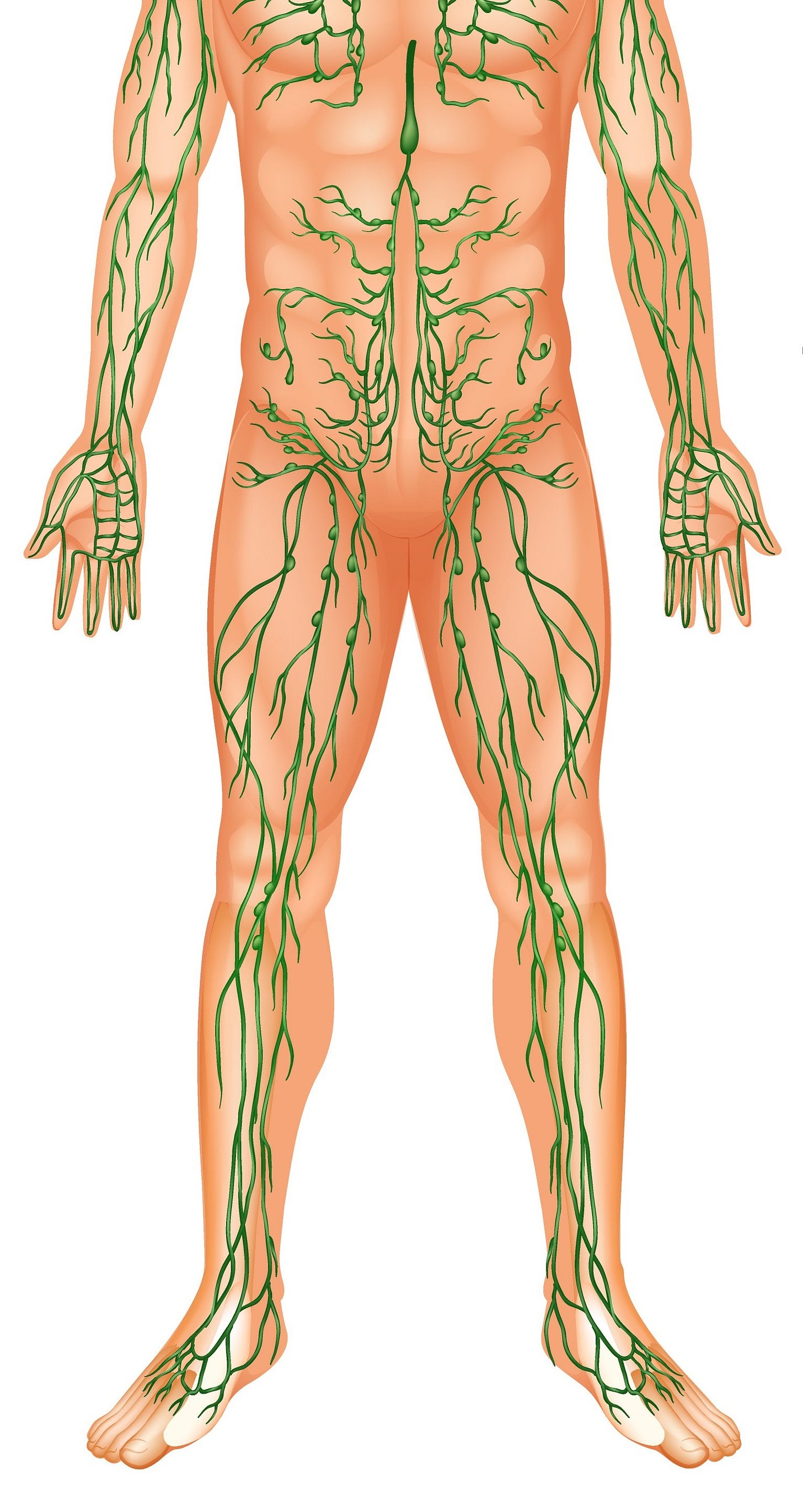
When certified lymphatic therapists begin to work on the lymphatic system, we typically begin with the deep breathing into the pelvic floor, and the Root Chakra, as it represents the foundation for your being and controls major lymphatic anatomical landmarks. The pelvic lymph nodes and vessels connect to the deep trunks and the cisterna chyli. This is the mothership of all lymphnodes and can be seen in the image below as the dark green teardrop just above the bellybutton, and the deep trunks extend into the pelvis, directly over the region of the root chakra. This area connects the lymphatic hub to the root chakra.
2. The Lower Meridians, Facia, and Lymph Connections
Meridians are traditionally described as pathways of flow throughout the body. The lower body meridians (legs, pelvis, lower abdomen) are often associated with: grounding, circulation, stability and energy returning upward toward the core. They also run parallel to vascular pathways in the body. These pathways mirror patterns of movement, pressure, and sensation.
Your body has fluid pathways (lymph vessels) and nerve pathways in your peripheral nervous system, and fascial lines where connective tissue meets muscles, tendons, and skin. Meridians intersect your natural fluid pathways in a powerful way.

Meridians can be understood as:
the felt experience of these interconnected systems working together
When people say: “I feel pain moving up my leg” or “I feel a catch in my hip," they are sensing multiple anatomical systems at once, and how they perceive the sensation is where my research lives.
So… What exactly is fascia and how does it connect to lymph?
It may be described as the ‘glue’ that holds all of our structures together.
Fascia, the connective tissue that surrounds and weaves through your entire body, plays a role in how pressure is distributed and how easily fluid can move.
When this tissue is hydrated, soft, and adaptable, fluid can pass through more easily. When it becomes more tense or resistant, pressure builds and movement becomes more difficult.
And while these sensations can coexist with medical conditions that require evaluation, they also reflect how the body is attempting to regulate itself in real time. Inflammation, arthritis, tears, breaks, clots, may sometimes be felt physically as a block or focused pain. Holistic care holds space in our bodies and deserves a place in the discussion.
Kidney, Liver, and Spleen Meridians: Yin (of the Yin and Yang) travel up the inner thighs to the pubic area. This is also a major anatomical lympho-vascular watershed and pathway to the hip or inguinal anastomoses (lymph node area).
interestingly, when swelling is being addressed, there are labs drawn to look at the bun and creatinine ratio, a key indicator of the kidney and lymph relationship (waste fluid efficiencies).
The Tailbone (Dai Mai) Meridian supports the emotional connection of the pelvis, stabilizing this primary landmark. This region also may support our deep fascia, including the pelvic floor muscle link to our deep diaphragmatic breathing patterns, and our internal pressure of the lymphatic flow system.
3. What are Mudras?
Mudras are specific hand positions used in meditation or stillness.

They may seem simple, but they serve a mighty purpose. They may support focused attention, regulate breathing, and anchor awareness in the body.
From a physiological perspective: (and my favorite anatomical word)
The Homunculus
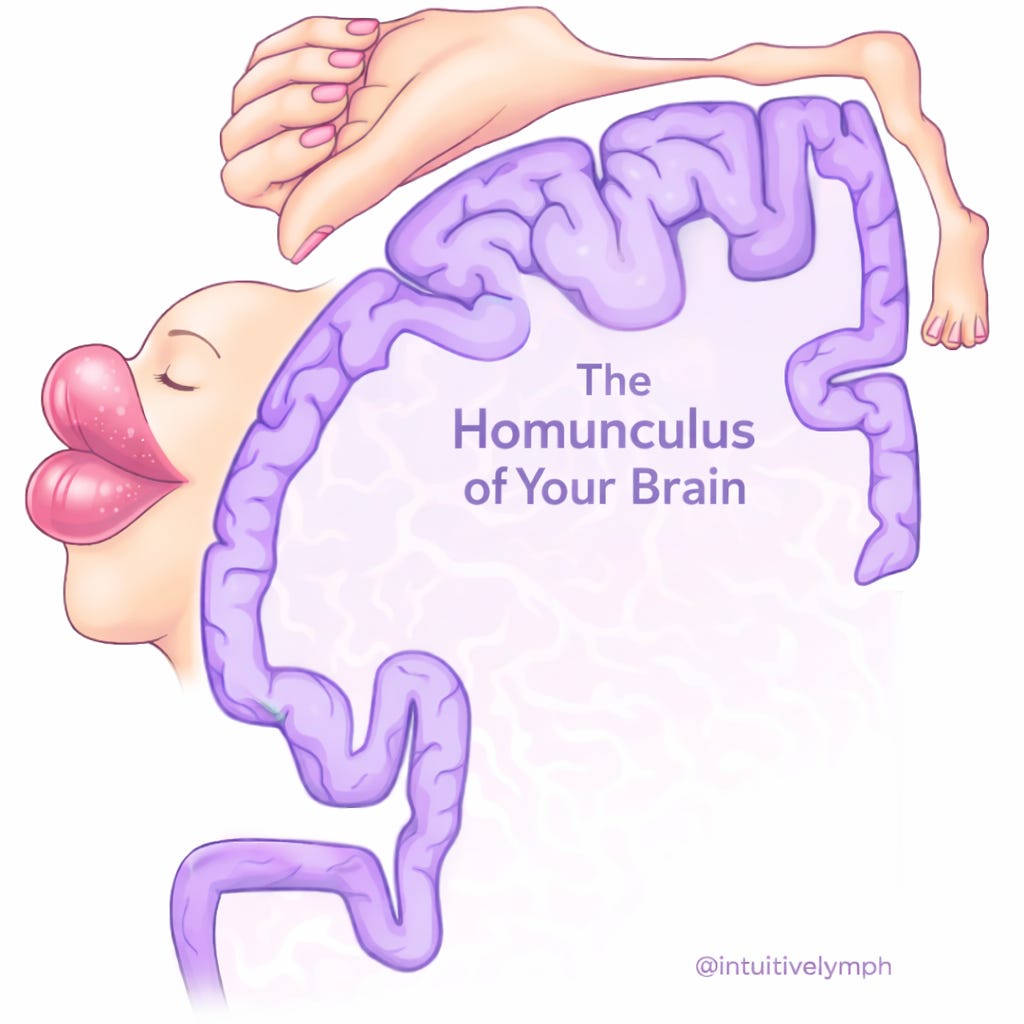
Your hands have a large representation in the brain. Your brain and cortex feel a lot through your hands. Changing a hand position can shift attention and nervous system tone, bring awareness to specific areas of the body. When certified lymphatic practitioners use their hands to massage the skin, they are directing flow towards potent anatomical pathways, and mudras can further direct this energy in a positive way.
From a perceptual standpoint:
Mudras give your brain a signal of intention and safety
For example:
palms down feels grounding. Palms up feels open.
hands resting gently feels relaxed. Hands fisted tight feels tense.
fingers touching brings focus and awareness.
This matters because when attention changes, the nervous system shifts, and pressure patterns in the body can change. Mudras are very powerful. I use them to release energetic cords and in manual lymph drainage (MLD) techniques when presented with a cording syndrome (axillary or wherever else they pop up.)
4. What is the lymph system and Inguinal Anastomoses?
Now we move into the physical anchor: The Lymphatic System
The lymphatic system is your body’s fluid movement and cleanup system. It is made up of vessels, lymph nodes and fluid that moves through your tissues. Its role is to collect excess fluid from your body, carry waste products, proteins, and cellular debris and return that fluid back into circulation or eliminate waste. Fluid is constantly created, distributed, recycled, and eliminated from your body (urine, for example.)
Unlike your blood system, the lymphatic system does not have a pump. Instead, it relies on movement, breathing muscle contraction, and gentle pressure changes. This means your body has to create and manage flow. Constantly.
Practices of guided breathing and lymphatic awareness can support the system by changing internal pressure, parasympathetic nervous system support, and awareness.
Why Swelling Happens
Swelling develops when more fluid enters the tissue than the body can move out. Its an overflow of fluid into a small area, like an overfilled water balloon. This can happen when high pressure inside the tissues increases, movement is reduced, tissues become stiff or resistant, or the system becomes overwhelmed and confused. Swelling is especially affected by gravity because the fluid tends to be more dense (legs, lower body).
The inguinal region (your groin area) is one of the most important crossroads in the lymphatic system.
The inguinal anastomoses are connections between lymphatic pathways in the lower body and the central drainage system. This area helps move fluid from the legs upward, redirect flow when pathways are overwhelmed and balance pressure between regions. It’s where your rivers of lymph meet the lymphatic ocean in your abdomen.
You can think of it as:
A major traffic intersection or “drainage highway”
If this area is compressed, tight, or sticky, then fluid from the legs can slow down, pool and feel heavy. This often happens as a result of surgery, trauma, constipation, inflammation, and other conditions. It is highly recommended to consult a provider that is certified in CDT- complete decongestive treatment, rather than just MLD- manual lymph drainage- to look at your complete health history prior to starting lymph drainage techniques. Some treatments may be harmful and not beneficial if you have certain conditions.
5. How These All Connect
Now let’s bring it together.
(If you’re still reading, now is a great time to subscribe and stay in the neural loop).
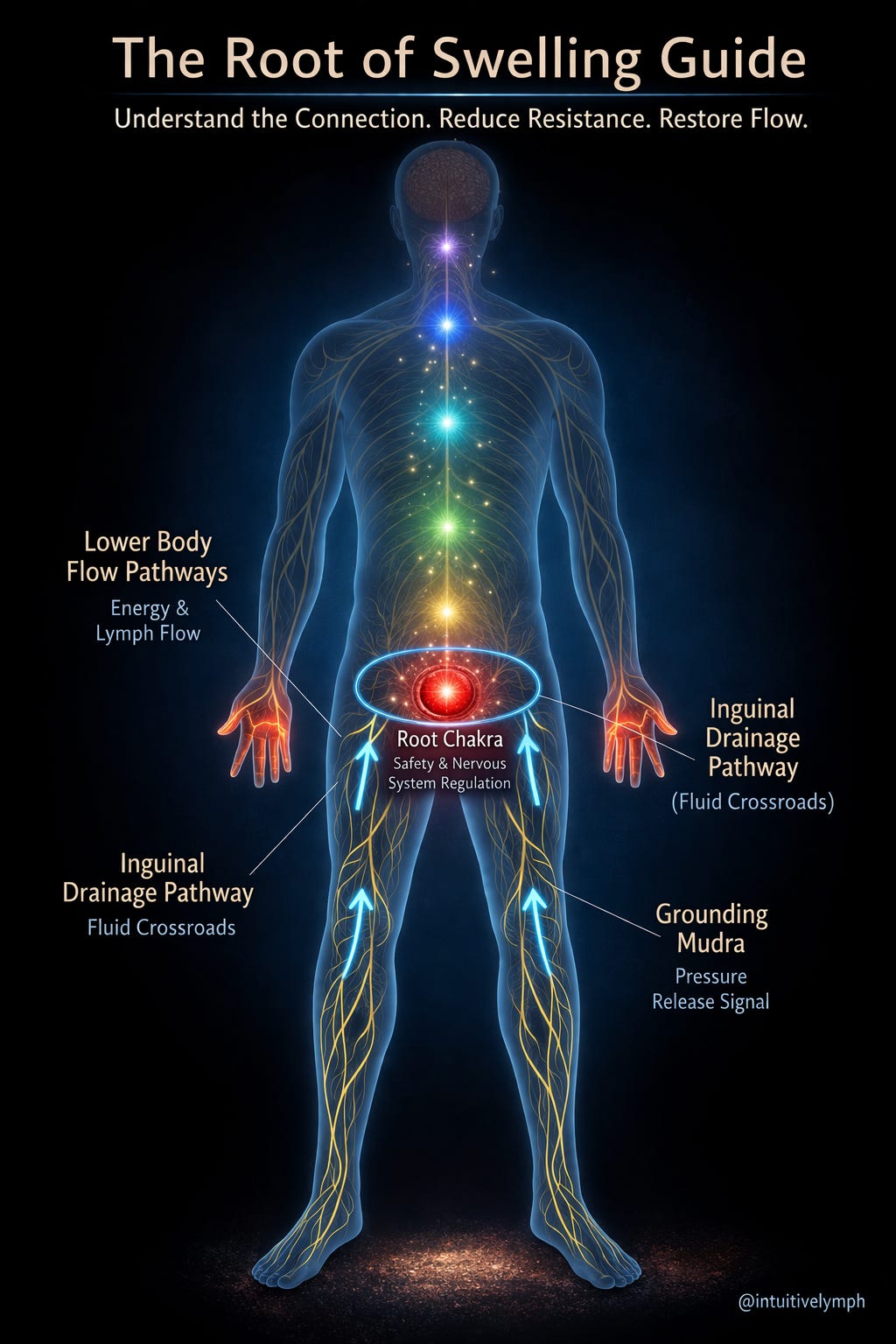
The Root Chakra sets the tone
If your system feels unsafe or guarded, pelvic floor tightens, hips brace and the lower body stiffens.
The Meridians reflect the pathways of flow
You may feel:
heaviness, blockage, or lack of upward movement, stuck.
The Inguinal Anastomoses handle the physical flow
If there is tension or pressure here: fluid has difficulty moving upward and the system may feel congested
Mudras influence the nervous system
They help shift your state, reduce guarding and improve awareness.
Start here:
1. Ground (Root)
Sit comfortably
feel your legs supported
take 3 slow belly breaths
2. Gentle Awareness (Meridians)
lightly notice your skin
no forcing, just observing
3. Light Touch (Inguinal Region)
very gentle, skin-level contact
no pressure
4. Hand Position (Mudra)
rest hands on thighs, palms down
signal safety and grounding
Your body is a coordinated system of pressure, perception, and nervous system response. When those systems align, flow becomes easier.
Experience This in Your Body
If you’ve been noticing heaviness, tightness, or a sense of disconnection in your body,
You can begin by shifting the conditions in your body.
I created a short guided lymphatic meditation to help you slow down, reconnect to your body and gently support internal flow.
Listen here: FreetheFlow complementary download
Continued Learning:
Read: FAQ
Citations:
Slater AM, Barclay SJ, Granfar RMS, Pratt RL. Fascia as a regulatory system in health and disease. Frontiers in Neurology. 2024.
This Substack is a reader-supported publication. To receive new posts and support my work, consider becoming a subscriber.
Thanks for reading my post. It means a lot to me. This post is free to share with someone who know who might enjoy reading about anatomy and physiology.